
Crestron DMPS3-300-C Digital Media Presentation System 300 SKU: DMPS3-300C-R
Crestron DMPS3-300-C Digital Media Presentation System 300 SKU: DMPS3-300C-R


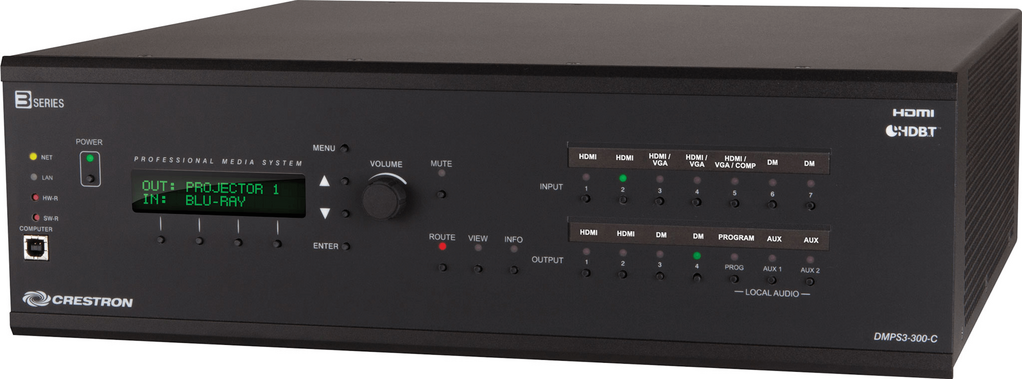
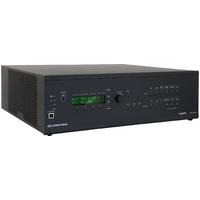
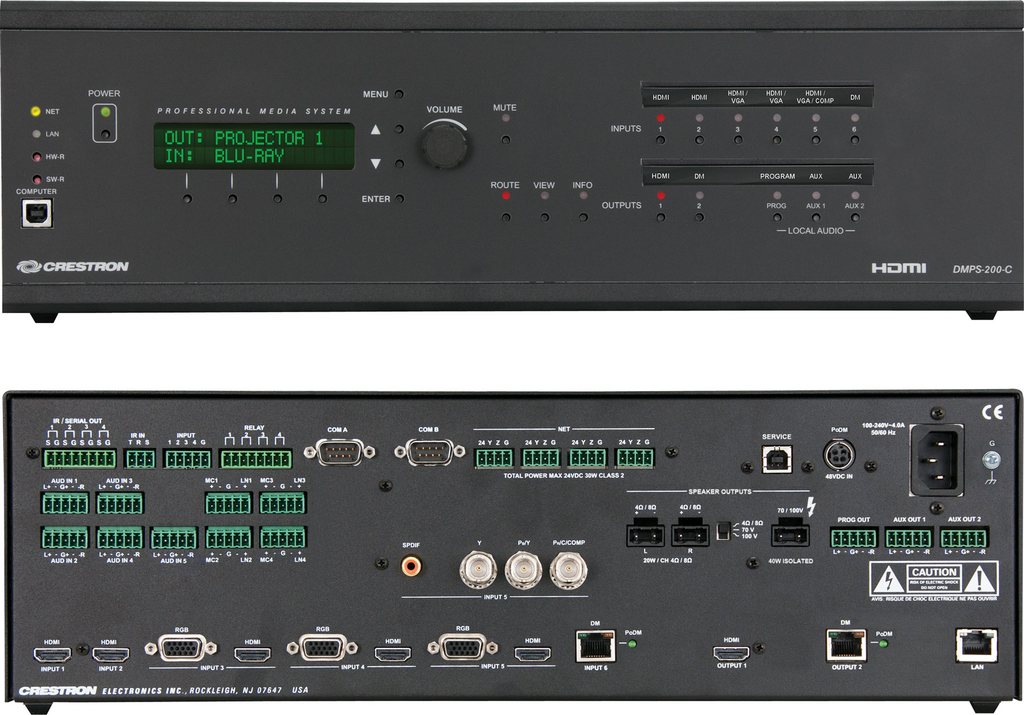
The DMPS3-300-C from Crestron® delivers a complete, high-definition presentation control and signal routing solution for classrooms, boardrooms, lecture halls, and videoconference rooms. It integrates the control system, multi-format matrix switcher, mic mixer, audio DSP, and amplifier all into one 3-space rack mount package. The DMPS3-300-C offers extensive signal routing flexibility and high-performance signal processing without the need for separate components. Auto-configuring inputs enable plug-and-play compatibility with a wide range of digital and analog sources. Built-in DigitalMedia 8G+® and HDBaseT® connectivity affords a streamlined, long-distance wiring solution for remote sources and display devices, and for facility-wide integration as part of a larger media distribution system.
(DMPS3-300C-R)
Operating System |
||
| Crestron® 3-Series®; real-time, preemptive, multi-threaded/multitasking kernel; Transaction-Safe Extended FAT file system; supports up to 10 simultaneously running programs; preloaded DMPS3 .AV Framework™ Base Program | ||
Memory |
||
| SDRAM | 512 MB | |
| Flash | 4 GB | |
Communications |
||
| Ethernet | 10/100/1000 Mbps, auto-switching, auto-negotiating, auto-discovery, full/half duplex, industry-standard TCP/IP stack, UDP/IP, CIP, DHCP, SSL, TLS, SSH, SFTP (SSH File Transfer Protocol), FIPS 140-2 compliant encryption, IEEE 802.1X, SNMP, BACnet™/IP [10], IPv4 or IPv6, Active Directory authentication, IIS v.6.0 web server, SMTP e-mail client, RSTP, Private Network Mode | |
| Cresnet® | Cresnet master mode | |
| USB | USB signal routing via select DM transmitters and receivers, or via USB-EXT-DM extenders [8]; USB device port for computer console (setup) | |
| RS-232 | 2-way device control and monitoring up to 115.2k baud with hardware and software handshaking | |
| IR/Serial | 1-way device control via infrared up to 1.2 MHz or serial TTL/RS-232 (0-5 Volts) up to 115.2k baud; supports CNXRMIRD IR Receiver [7] | |
| DigitalMedia™ | DM 8G+®, HDCP, EDID, CEC, PoDM, Ethernet | |
| HDBaseT® | HDCP, EDID, PoH, Ethernet | |
| HDMI® | HDCP, EDID, CEC | |
| NOTE: Supports management of HDCP and EDID; supports management of CEC between the connected HDMI devices and the control system | ||
Video |
||
| Switcher | 7x4 matrix, auto-switching, auto-detecting multi-format digital/analog source inputs, QuickSwitch HD™ technology | |
| Input Signal Types | HDMI w/Deep Color & 3D [4] (DVI & Dual-Mode DisplayPort compatible [2]), DM 8G+ & HDBaseT w/Deep Color & 3D [4], RGB/VGA (RGBHV, RGBS, RGsB) [9], component (YPbPr), S-Video (Y/C), composite (NTSC, PAL) | |
| Output Signal Types | HDMI w/Deep Color & 3D [4] (DVI compatible [2]), DM 8G+ & HDBaseT w/Deep Color & 3D [4] | |
| Input Resolutions, HDMI & HDBaseT, Progressive | 640x480@60Hz, 720x480@60Hz (480p), 720x576@50Hz (576p), 800x600@60Hz, 848x480@60Hz, 852x480@60Hz, 854x480@60Hz, 1024x768@60Hz, 1024x852@60Hz, 1024x1024@60Hz, 1280x720@50Hz (720p50), 1280x720@60Hz (720p60), 1280x768@60Hz, 1280x800@60Hz, 1280x960@60Hz, 1280x1024@60Hz, 1360x768@60Hz, 1365x1024@60Hz, 1366x768@60Hz, 1400x1050@60Hz, 1440x900@60Hz, 1600x900@60Hz, 1600x1200@60Hz, 1680x1050@60Hz, 1920x1080@24Hz (1080p24), 1920x1080@25Hz (1080p25), 1920x1080@50Hz (1080p50), 1920x1080@60Hz (1080p60), 1920x1200@60Hz, 2048x1080@24Hz, 2048x1152@60Hz, plus any other resolution allowed by HDMI up to 165MHz pixel clock | |
| Input Resolutions, HDMI & HDBaseT, Interlaced | 720x480@30Hz (480i), 720x576@25Hz (576i), 1920x1080@25Hz (1080i25), 1920x1080@30Hz (1080i30), plus any other resolution allowed by HDMI up to 165MHz pixel clock | |
| Input Resolutions, RGB | 640x480@60Hz, 720x480@60Hz (480p), 720x576@50Hz (576p), 800x600@60Hz, 848x480@60Hz, 1024x768@60Hz, 1280x720@50Hz (720p50), 1280x720@60Hz (720p60), 1280x768@60Hz, 1280x800@60Hz, 1280x960@60Hz, 1280x1024@60Hz, 1360x768@60Hz, 1366x768@60Hz, 1400x1050@60Hz, 1440x900@60Hz, 1600x1200@60Hz, 1680x1050@60Hz, 1920x1080@50Hz (1080p50), 1920x1080@60Hz (1080p60), 1920x1200@60Hz, 2048x1152@60Hz | |
| Input Resolutions, Component | 480i, 576i, 480p, 576p, 720p50, 720p60, 1080p24, 1080i25 (1125 lines), 1080i30, 1080p30, 1080p50 (1125 lines), 1080p60 | |
| Input Resolutions, Composite & S-Video | 480i, 576i | |
| Output Resolutions | Matched to inputs | |
| Analog-To-Digital Conversion | 10-bit 165 MHz per each of 3 channels | |
| RGB Source Image Adjustments | Brightness: 0% to 50%; Contrast: -50% to +50%; Fine Phase: -16 to +15; X Position: -100 to +100; Y Position: -10 to +10; RGB Gains: -50 to +50, separately adjustable for Red, Green, and Blue |
|
| YPbPr, Y/C, or Composite Source Image Adjustments | Brightness: 0% to 50%; Contrast: -50% to +50%; Saturation: -50% to +50%; Hue: -50% to +50% |
|
Audio – General |
||
| Switcher/Mixer | 7x7 stereo source switcher, auto-detecting multi-format digital/analog source inputs, audio-follow-video or breakaway, 6-channel gated mic mixer w/DSP, independent 6-ch mic + source mixer per output, dual codec mixer, independent stereo DSP per analog output, integrated power amplifier, 7x4 multichannel source switcher, digital audio mixer bypass mode for multichannel pass-through to digital outputs | |
| Analog-To-Digital Conversion | 24-bit 48 kHz | |
| Digital-To-Analog Conversion | 24-bit 48 kHz | |
| Frequency Response, Digital & Analog Line Outputs | 20 Hz to 20 kHz ±0.5 dB (digital source); 20 Hz to 20 kHz ±0.5 dB (analog line source); 20 Hz to 20 kHz ±0.7 dB (microphone source) |
|
| Frequency Response, Speaker Output | 20 Hz to 20 kHz ±1 dB @ 20 Watts into 8 Ohms; 100 Hz to 20 kHz ±2.5 dB @ 70 or 100 Volts |
|
| S/N Ratio, Digital & Analog Line Outputs | >108 dB, 1 kHz, A-weighted (digital source); >103 dB, 1 kHz, A-weighted (analog line source) |
|
| S/N Ratio, Speaker Output | 98 dB @ 20 Watts into 8 Ohms, 1 kHz, A-weighted; 96 dB @ 20 Watts into 4 Ohms, 1 kHz, A-weighted |
|
| THD+N, Digital & Analog Line Outputs | <0.002%, 20 Hz to 20 kHz (digital source); <0.005%, 20 Hz to 20 kHz (analog line source); <0.05%, 20 Hz to 20 kHz (microphone source) |
|
| THD+N, Speaker Output | <0.1%, 1 kHz @ 20 Watts into 4 or 8 Ohms; <0.7%, 20 Hz to 20 kHz @ 20 Watts into 4 or 8 Ohms |
|
| Stereo Separation, Digital & Analog Line Outputs | >108 dB (digital source); >103 dB (analog source) |
|
| Stereo Separation, Speaker Output | >65 dB @ 20 Watts, 1 kHz | |
| Channel Separation, Digital Outputs | >108 dB (digital source); >103 dB (analog source) |
|
| Channel Separation, Analog Line Outputs | >103 dB | |
| Speaker Output Modes | 4Ω/8Ω stereo, 70V mono, or 100V mono | |
| Speaker Amplifier Output Power | 20 Watts RMS per channel @ 8 Ohms, 4 Ohms tolerant; 40 Watts RMS @ 70 or 100 Volts |
|
Audio – Microphone Inputs |
||
| Typical of 6 microphone input channels (Mic/Line 1 – 6) | ||
| Input Signal Types | Mono analog mic or line level | |
| Phantom Power | Enable/Disable per channel | |
| Gain | 0 to +60 dB Gain adjustment, plus Mute | |
| Delay | 0.0 to 85.0 ms | |
| EQ Center Frequencies | 50 to 200 Hz (Band 1), 200 to 800 Hz (Band 2), 800 to 3.2k Hz (Band 3), 3.2k to 12.8k Hz (Band 4) | |
| EQ Gain | ±12.0 dB per band | |
| High-Pass Filter | On or Off | |
| Gating Threshold | -80 to 0 dB | |
| Gating Depth (Attenuation) | -80 to 0 dB | |
| Gating Attack | 1 to 250 ms | |
| Gating Release | 1 to 1000 ms | |
| Compression Threshold | -80 to 0 dB | |
| Compression Ratio | 1:1 to 10:1 | |
| Compression Attack | 1 to 250 ms | |
| Compression Release | 1 to 1000 ms | |
| Compression Curve | Hard or soft knee | |
Audio – Source Inputs |
||
| Typical of 7 source input channels (Input 1 – 7 & Audio In 1 – 5) | ||
| Input Signal Types | HDMI (Dual-Mode DisplayPort compatible [2]) on Inputs 1-5, analog 2-channel on Inputs 1-5, S/PDIF on Input 5 only, DM 8G+ & HDBaseT on Inputs 6 & 7 | |
| Analog Formats | Stereo 2-channel | |
| Digital Formats, HDMI & DM | Dolby Digital®, Dolby Digital EX, Dolby Digital Plus [4], Dolby® TrueHD [4], Dolby Atmos® [4]; DTS®, DTS-ES, DTS 96/24, DTS-HD High Res [4], DTS-HD Master Audio™ [4], LPCM up to 8 channels | |
| Digital Formats, SPDIF | LPCM 2-channel | |
| Input Compensation | ±10.0 dB [3] | |
Audio – Analog Line & Speaker Outputs |
||
| Typical of 1 analog line/speaker output (Program Out & Speaker Outputs) and 2 analog line outputs (Aux Out 1 – 2) | ||
| Output Signal Type/Format | Stereo 2-channel | |
| Mic 1 – 6 | -80 to +10 dB Level adjustment range, plus Mute and Pan | |
| Mics Master | -80 to +10 dB Level adjustment range, plus Mute | |
| Source | -80 to +10 dB Level adjustment range, plus Mute and Balance | |
| Codec 1 – 2 | -80 to +10 dB Level adjustment range, plus Mute and Balance (Codec 1 available at Program Out and Aux 2 Out only, Codec 2 available at Program Out and Aux 1 Out only) [11] | |
| Master Volume | -80 to +10 dB Level adjustment range, plus Mute and Mono | |
| Mixer Presets | 1 through 5 | |
| Bass | ±12.0 dB | |
| Treble | ±12.0 dB | |
| Equalization | 10-band graphic + 4-band parametric | |
| GEQ Center Frequencies | 31.5, 63, 125, 250, 500, 1k, 2k, 4k, 8k, 16k Hz | |
| GEQ Gain | ±12.0 dB per band | |
| PEQ Center Frequencies | 10 to 22000 Hz per band | |
| PEQ Gain | -36.0 to +24.0 dB per band | |
| PEQ Bandwidth | 0.02 to 3.50 octaves per band | |
| PEQ Types | Peaking EQ, High Pass, Low Pass, High Shelf, Low Shelf, Notch | |
| Delay | 0.0 to 85.0 ms | |
| Limiter Threshold | -80 to 0 dBz | |
| Limiter Ratio | 1:1 to 10:1 | |
| Limiter Attack | 1 to 250 ms | |
| Limiter Hold | 1 to 200 ms | |
| Limiter Release | 1 to 1000 ms | |
| Limiter Curve | Hard or soft knee | |
| EQ Presets | 1 through 10 (includes Delay and Limiter settings) | |
Audio – Digital Outputs |
||
| Typical of 4 digital outputs (HDMI Output 1 – 2 & DM Output 3 – 4) | ||
| Output Signal Types | HDMI (DVI compatible [2]) on Outputs 1 & 2, DM 8G+ & HDBaseT on Outputs 3 & 4 | |
| Formats | Dolby Digital, Dolby Digital EX, Dolby Digital Plus, Dolby TrueHD, Dolby Atmos, DTS, DTS-ES, DTS 96/24, DTS-HD High Res, DTS-HD Master Audio, LPCM up to 8 channels | |
| Mic 1 – 6 | -80 to +10 dB Level adjustment range, plus Mute and Pan [3] | |
| Mics Master | -80 to +10 dB Level adjustment range, plus Mute [3] | |
| Source | -80 to +10 dB Level adjustment range, plus Mute and Balance [3] | |
| Master Volume | -80 to +10 dB Level adjustment range, plus Mute [3] | |
| Mixer Presets | 1 through 5 | |
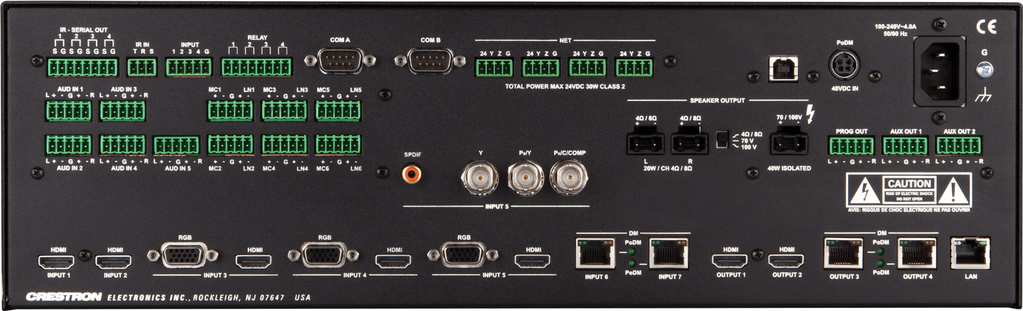
Connectors – Audio/Video Inputs |
||
| HDMI INPUT 1 – 5 | (5) 19-pin Type A HDMI female; Digital video/audio inputs; Signal Types: HDMI, DVI, or Dual-Mode DisplayPort [2,4] |
|
| RGB INPUT 3 – 5 | (3) HD15 female; Analog RGB/VGA/video inputs; Signal Types: VGA, RGB, component, S-Video, or composite [9]; Formats: RGBHV, RGBS, RGsB, YPbPr, Y/C, NTSC or PAL; Input Level: 0.5 to 1.5 Vp-p with built-in DC restoration; Input Impedance: 75 Ohms nominal; Sync Detection: RGBHV, RGBS, RGsB, YPbPr; Sync Input Level: 3 to 5 Vp-p; Sync Input Impedance: 2.2k Ohms; Note: RGB Inputs 3-5 and HDMI Inputs 3-5 are mutually exclusive; HDMI overrides RGB when using the auto-switching feature |
|
| Y, PB/Y, PR/C/COMP INPUT 5 | (3) BNC female; Comprises (1) auto-sensing multi-format analog video input; Signal Types: Component, S-Video, or composite; Formats: YPbPr, Y/C, NTSC or PAL; Input Level: 1 Vp-p nominal; Input Impedance: 75 Ohms nominal; Note: Video Input 5, RGB Input 5, and HDMI Input 5 are mutually exclusive; HDMI and RGB override Video when using the auto-switching feature |
|
| SPDIF INPUT 5 | (1) RCA female; S/PDIF coaxial digital audio input; Input Impedance: 75 Ohms; Note: SPDIF Input 5 and HDMI Input 5 are mutually exclusive; HDMI overrides SPDIF when using the auto-switching feature |
|
| AUD IN 1 – 5 | (5) 5-pin 3.5 mm detachable terminal blocks; Balanced/unbalanced stereo line-level analog audio inputs; Input Impedance: 24k Ohms balanced/unbalanced; Maximum Input Level: 4 Vrms balanced, 2 Vrms unbalanced; Note: Analog Audio Inputs 1-5, SPDIF Input 5, and HDMI Inputs 1-5 are mutually exclusive; HDMI and SPDIF override Analog Audio when using the auto-switching feature |
|
| DM INPUT 6 – 7 | (2) 8-pin RJ45 female, shielded; DM 8G+ inputs, HDBaseT compliant; PoDM and PoH PSE (Power Sourcing Equipment) ports [6]; Each connects to the DM 8G+ output of a DM transmitter or other DM device, or to an HDBaseT device, via CAT5e or Crestron DM-CBL-8G cable [5] |
|
| MC1/LN1 – MC6/LN6 | (6) 5-pin 3.5 mm detachable terminal blocks; Comprises (6) balanced microphone/line audio inputs; Balanced Mic Input Level: -60 to 0 dBV, 1 Vrms maximum; Balanced Line Input Level: -31 to +11 dBV, 3.7 Vrms maximum; Unbalanced Line Input Level: -37 to +5 dBV, 1.85 Vrms maximum; Mic Input Impedance: 3.9k Ohms balanced; Line Input Impedance: 19k Ohms balanced, 9.5k Ohms unbalanced; Phantom Power: 48 Volts DC, software enabled/disabled per channel |
|
Connectors – Audio/Video Outputs |
||
| SPEAKER OUTPUTS 4Ω/8Ω L – R |
(2) 2-pin 7.62 mm 15A detachable terminal blocks; 4-8 Ohm stereo speaker-level audio output; Wire Size: Terminals accept up to 14 AWG; Output Power: 20W RMS per channel stereo at 8 Ohms, 4 Ohms tolerant |
|
| SPEAKER OUTPUTS 70/100V | (1) 2-pin 7.62 mm 15A detachable terminal block; Transformer-isolated 70 or 100 Volt mono speaker-level audio output; Wire Size: Terminals accept up to 14 AWG; Output Power: 40W RMS mono at 70 or 100 Volts; Note: 4Ω/8Ω and 70/100V outputs are mutually exclusive |
|
| PROG OUT | (1) 5-pin 3.5 mm detachable terminal block; Balanced/unbalanced stereo line-level audio output; Output Impedance: 200 Ohms balanced, 100 Ohms unbalanced; Maximum Output Level: 4 Vrms balanced, 2 Vrms unbalanced |
|
| AUX OUT 1 – 2 | (2) 5-pin 3.5 mm detachable terminal blocks; Balanced/unbalanced stereo line-level audio outputs; Output Impedance: 200 Ohms balanced, 100 Ohms unbalanced; Maximum Output Level: 4 Vrms balanced, 2 Vrms unbalanced |
|
| HDMI OUTPUT 1 – 2 | (2) 19-pin Type A HDMI female; Digital video/audio outputs; Signal Types: HDMI, DVI [2] |
|
| DM OUTPUT 3 – 4 | (2) 8-pin RJ45 female, shielded; DM 8G+ outputs, HDBaseT compliant; PoDM and PoH PSE (Power Sourcing Equipment) ports [6]; Each connects to the DM 8G+ input of a DM receiver or other DM device, or to an HDBaseT device, via CAT5e or Crestron DM-CBL-8G cable [5] |
|
Connectors – Control & Power |
||
| IR/SERIAL OUT 1 – 4 | (4) 2-pin 3.5 mm detachable terminal blocks; IR/Serial output ports; IR output up to 1.2 MHz; 1-way serial TTL/RS-232 (0-5 Volts) up to 115.2k baud |
|
| IR IN | (1) 3-pin 3.5 mm detachable terminal block; For connection of the CNXRMIRD IR Receiver [7]; Allows control from IR wireless remotes using RC-5 command set |
|
| INPUT 1 – 4 | (1) 5-pin 3.5 mm detachable terminal block; Comprises (4) programmable digital inputs; Input Voltage Range: 0 to 24 Volts DC, referenced to GND; Logic Threshold: 2.5 Volts DC nominal with 1 Volt hysteresis band; Input Impedance: 10k Ohms at >5 Volts, 1M Ohms at <5 Volts; Pull-up Resistor: 2.2k Ohms per input |
|
| RELAY 1 – 4 | (1) 8-pin 3.5 mm detachable terminal block; Comprises (4) normally open, isolated relays; Rated 1 Amp, 30 Volts AC/DC; MOV arc suppression across contacts |
|
| COM A – B | (2) DB9 male; Bidirectional RS-232 ports; Up to 115.2k baud, hardware and software handshaking support |
|
| NET | (4) 4-pin 3.5 mm detachable terminal blocks; Cresnet Master ports, paralleled; Available Cresnet Power: 30 Watts |
|
| SERVICE | (1) USB Type B female; For factory use only |
|
| PoDM 48VDC IN | (1) 4-pin snap & lock DC power connector, female; 48 Volt DC power input for PoDM power pack [6]; Enables PoDM and PoH power sourcing |
|
| 100-240V~4.0A 50/60Hz | (1) IEC 60320 C14 main power inlet; Mates with removable power cord, included |
|
| G | (1) 6-32 screw, chassis ground lug | |
| LAN | (1) 8-pin RJ45 female; 10Base-T/100Base-TX/1000Base-T Ethernet port |
|
| COMPUTER (front) | (1) USB Type B female (cable sold separately); USB computer console port (for setup only) |
|
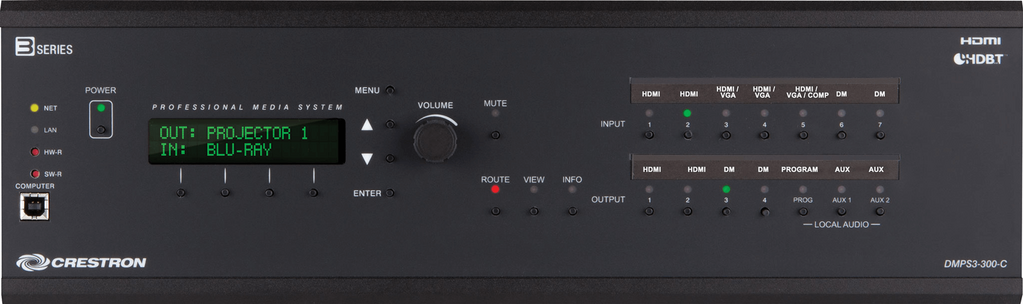
Controls & Indicators |
||
| NET | (1) Yellow LED, indicates Cresnet bus activity | |
| LAN | (1) Yellow LED, indicates Ethernet activity | |
| HW-R | (1) Recessed pushbutton for hardware reset, reboots the control system | |
| SW-R | (1) Recessed pushbutton for software reset, restarts the SIMPL program | |
| POWER | (1) Pushbutton and green LED, programmable for system power control | |
| LCD Display | (1) Green LCD alphanumeric; adjustable backlight; 2 lines x 20 characters per line; displays input/outputs by name, volume levels, setup menus, signal routing, device info, and other system information | |
| SOFTKEYS | (4) Pushbuttons for activation of LCD driven functions and passcode entry | |
| MENU | (1) Pushbutton, steps menu back one level | |
| Λ, V | (2) Pushbuttons, scroll up or down through menu and adjust menu parameters | |
| ENTER | (1) Pushbutton, executes highlighted menu or value | |
| VOLUME | (1) Continuous turn rotary encoder, adjusts menu parameters, defaults to Program audio volume | |
| MUTE | (1) Pushbutton and red LED, mutes the Program audio output | |
| ROUTE | (1) Pushbutton and red LED, selects ROUTE mode to allow routing changes | |
| VIEW | (1) Pushbutton and red LED, selects VIEW mode to view current routing | |
| INFO | (1) Pushbutton and red LED, selects INFO mode to view AV and device info | |
| INPUTS 1 – 7 | (7) Pushbuttons and red LEDs, select input to be routed | |
| OUTPUTS 1 – 4, PROG, AUX 1 – 2 | (7) Pushbuttons and red LEDs, select output destination(s) | |
| SPEAKER OUTPUTS (rear) | (1) 3-position slide switch, selects the amplifier output configuration | |
| DM INPUT 6 – 7 (rear) | (4) LEDs, green LEDs indicate DM link status, amber LEDs indicate video and HDCP signal presence, for each respective port | |
| DM INPUT 6 – 7 PoDM (rear) | (2) Green LEDs, indicate upstream device is drawing power over DM for each respective port | |
| DM OUTPUT 3 – 4 (rear) | (4) LEDs, green LEDs indicate DM link status, amber LEDs indicate video and HDCP signal presence, for each respective port | |
| DM OUTPUT 3 – 4 PoDM (rear) | (2) Green LEDs, indicate downstream device is drawing power over DM for each respective port | |
| LAN (rear) | (2) LEDs, bi-color LED (left) indicates Ethernet speed and activity, green LED (right) indicates Ethernet link status | |
Power Requirements |
||
| Main Power | 4 Amps @ 100-240 Volts AC, 50/60 Hz | |
| Power Consumption | 81 Watts typical | |
| Available Cresnet Power | 30 Watts | |
| Power over DM (PoDM) | PoDM PSE (Power Sourcing Equipment), each DM INPUT/OUTPUT port supplies up to 15.4 Watts (Class 0-3) to one PoDM Powered Device [6] | |
| Power over HDBaseT (PoH) | PoH PSE (Power Sourcing Equipment), each DM INPUT/OUTPUT port supplies up to 15.4 Watts (Class 0-3) to one PoH Powered Device [6] | |
| PoDM Power Pack | 1.875 Amp @ 48 Volts (100-240 Volts AC, 50/60 Hz power pack, model PW-4818DU sold separately) | |
Environmental |
||
| Temperature | 41° to 104° F (5° to 40° C) | |
| Humidity | 10% to 90% RH (non-condensing) | |
| Heat Dissipation | 277 BTU/hr | |
Enclosure |
||
| Chassis | Metal, black finish, fan-cooled, vented sides | |
| Front Panel | Metal, black finish with polycarbonate label overlay | |
| Mounting | Freestanding or 3 RU 19-inch rack-mountable (adhesive feet and rack ears included) | |
Dimensions |
||
| Height | 5.20 in (133 mm) without feet | |
| Width | 17.28 in (439 mm); 19.00 in (483 mm) with rack ears |
|
| Depth | 16.31 in (415 mm) | |
Weight |
||
| 16.4 lb (7.5 kg) | ||
- Some features and functions described in this spec sheet may not be supported using .AV Framework. For a complete list of capabilities and options supported by .AV Framework, please visit: www.crestron.com/avframework.
- HDMI requires an appropriate adapter or interface cable to accommodate a DVI or Dual-Mode DisplayPort signal. CBL-HD-DVI interface cables are available separately.
- Routing of a multichannel audio signal via any HDMI or DM input and output requires the input to be set for “mixer bypass” mode. When that input is routed to a given digital output, all audio controls on that output are disabled, and the ability to simultaneously route microphone signals to that output is defeated. Mixer bypass mode also disables the Input Compensation control on that input.
- High-bitrate 7.1 encoded audio, 3D video, and Deep Color video signals are only supported via HDMI inputs 1 and 2, and DM inputs 6 and 7.
- For DM 8G+ or HDBaseT wiring, use Crestron DM-CBL-8G DigitalMedia 8G Cable or third-party CAT5e (or better) UTP or STP. (Crestron legacy DM-CBL DigitalMedia Cable or DM-CBL-D DigitalMedia D Cable may also be used.) The maximum wire length for DM 8G+ is 330 ft (100 m) between devices. Shielded cable and connectors are recommended to safeguard against unpredictable environmental electrical noise which may impact performance at resolutions above 1080p. Refer to the Crestron DigitalMedia Design Guide, Doc. #4546 for complete system design guidelines. DM 8G+ is compatible with HDBaseT Alliance specifications for connecting to HDBaseT compliant equipment. All wire and cables are sold separately.
- Supplying Power over DM (PoDM) or Power over HDBaseT (PoH) requires an external power pack, model PW-4818DU, sold separately.
- Item(s) sold separately.
- Manages the routing of USB HID signals between peripheral DM devices that are equipped with USB HID ports. The USB ports onboard the DMPS3-300-C are not usable for USB signal routing. Also programmable to manage the routing of USB signals between Crestron USB over Ethernet Extender modules (USB-EXT-DM, sold separately). Refer to the USB-EXT-DM spec sheet for more information.
- The RGB/VGA inputs can accept component, composite, and S-Video signals using an appropriate adapter (not included). However, input sync detection is not provided for composite or S-Video signal types through the RGB connection.
- License required. The DMPS3-300-C supports a maximum of 500 BACnet objects when dedicated for BACnet use only. Actual capabilities are contingent upon the overall program size and complexity.
- The settings for CODEC 1 & 2 are global for all outputs that receive these signals.
| SKU | DMPS3-300C-R |
| Barcode # | 615678847897 |
| Brand | Crestron |
| Brand | Crestron |
| Type | Presentation Switcher |
| Model | DMPS3-200C |
| Shipping Cubic | 0.017794000m3 |
Be The First To Review This Product!
Help other Australian Computer Traders users shop smarter by writing reviews for products you have purchased.



 Help Centre
 Contact Us